
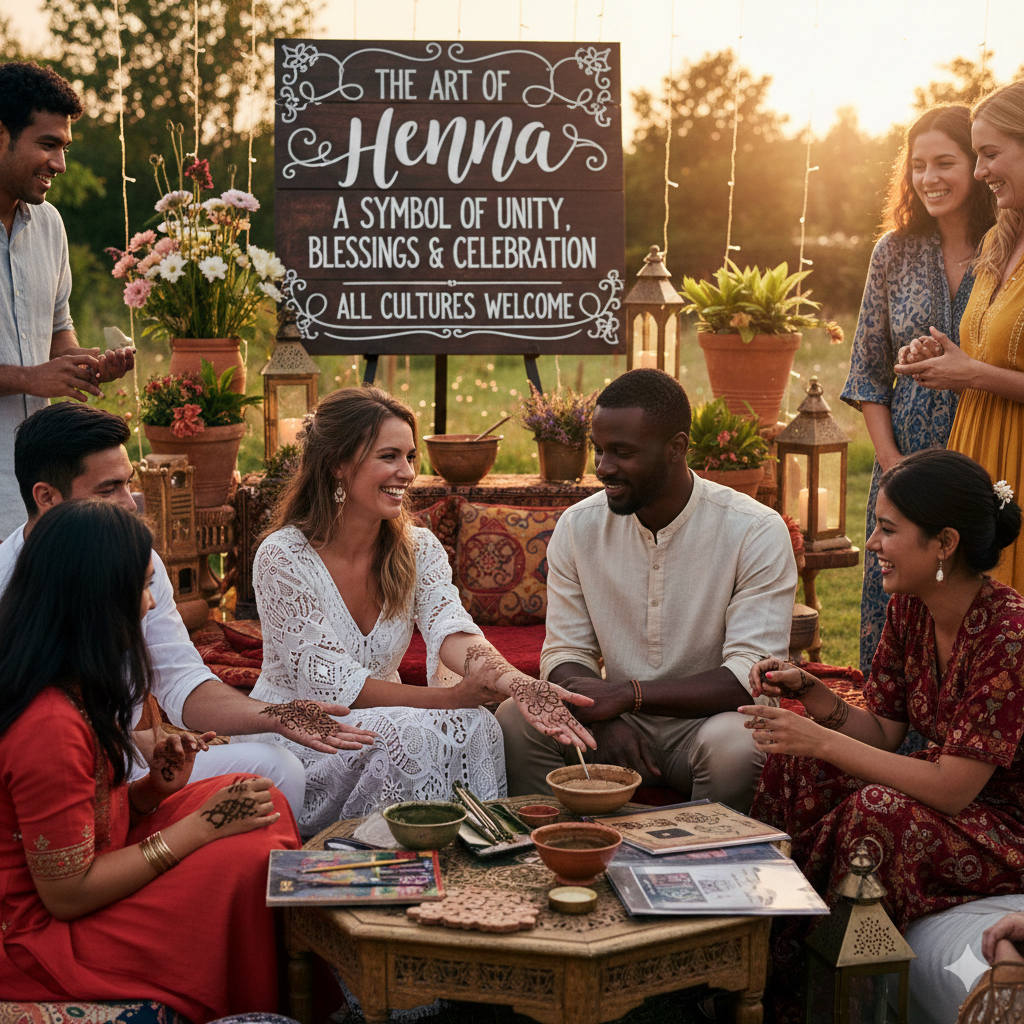
A bride in London recently said she chose mehndi for her wedding not because of tradition, but because she wanted something that felt more meaningful than a standard beauty appointment. She had seen it at a friend’s Indian wedding, felt the atmosphere it created, and wanted that same sense of intention at her own celebration.
She is not alone. Mehndi is increasingly being chosen by non-Indian brides — British, French, American, Australian, not as costume or novelty, but as a genuine expression of artistry and symbolism. But to use it meaningfully, it helps to understand what it actually represents, where those meanings come from, and how different cultures have interpreted the same art form for centuries.
This guide covers all of that including the specific symbols and their meanings, how mehndi traditions differ across South Asian, Middle Eastern, and North African cultures, and a practical guide for non-Indian couples who want to include it respectfully in their wedding.
Table of Contents
ToggleWhat Is Mehndi and Where Does It Come From?
Mehndi also called henna in Arabic and across the Middle East and North Africa, is the art of applying a paste made from the dried and powdered leaves of the Lawsonia inermis plant to the skin. The paste leaves a temporary stain ranging from pale orange to deep reddish-brown, depending on skin type, paste quality, and how long it is left on.
The practice is ancient. Archaeological evidence of henna use dates back more than 5,000 years, with historical records placing it in ancient Egypt, Persia, the Indian subcontinent, and across North Africa. Cleopatra is widely said to have used henna for adornment. Ancient mummies in Egypt have been found with henna-stained nails and hair.
What makes mehndi remarkable is that it developed independently and yet with striking similarities across multiple cultures simultaneously. Indian mehndi, Arabic mehndi, Moroccan henna, and Sudanese henna all share the same plant but developed completely different aesthetic traditions, different symbolic meanings, and different ceremonial contexts. Understanding these differences is the foundation for using mehndi respectfully.
Understanding the cultural meaning of mehndi helps brides make respectful and thoughtful design choices. For Western weddings, selecting the right style often involves balancing symbolism with aesthetics. This guide on how to choose a bridal mehndi design for Western weddings explains how brides can approach design selection with intention and clarity.
The Cultural Meaning of Mehndi Across Different Traditions
Mehndi does not have one single meaning — it has many, depending on which cultural tradition you are drawing from. Here is what it represents across the main traditions:
South Asian (Indian, Pakistani, Bangladeshi) Meaning
In South Asian traditions, bridal mehndi carries some of the richest symbolic layering of any wedding ritual.
The depth of colour is traditionally seen as a sign of the strength of love between the couple the darker the mehndi develops, the more deeply the couple is said to love each other. This is not superstition so much as a deeply embedded cultural expression of hope and blessing for the marriage.
Mehndi also symbolises:
- Fertility and prosperity, patterns incorporating flowers, vines, and fruits represent abundance in the new life ahead
- Protection — mehndi was historically believed to protect the bride from evil eye and negative energy on one of the most vulnerable transitions of her life
- The union of two families — in many Indian traditions, the groom’s name or initials are hidden within the bride’s mehndi pattern, and the groom must find them on the wedding night, symbolising how well he truly knows his bride
The Mehndi ceremony itself, a dedicated pre-wedding celebration often held 2–3 days before the wedding, is one of the most joyful events of an Indian wedding week. It is a gathering of women, music, dancing, singing, and laughter. It is not a solemn ritual. It is a celebration of the bride before her life changes.
If you are planning a bridal mehndi ceremony and want to know exactly what to prepare, read our complete guide: Plan a Mehndi Ceremony in 7 Days
Arabic and Gulf (Saudi, Emirati, Kuwaiti) Meaning
Arabic mehndi, the style most commonly seen in weddings across Saudi Arabia, UAE, Qatar, Kuwait, Bahrain, and Oman, is visually quite different from Indian mehndi. Where Indian designs are dense, detailed, and full-coverage, Arabic Khaleeji designs are characterised by bold, flowing floral and geometric motifs with significant negative space. The skin itself is as much a part of the design as the henna.
In Gulf culture, mehndi carries deep ceremonial significance. The henna night (Laylat Al-Henna) is an important pre-wedding occasion, often held separately from the wedding itself. Female family members gather, henna is applied to the bride, and the evening is marked by traditional music, gift-giving, and celebration.
In Gulf tradition, mehndi is also applied for Eid al-Fitr and Eid al-Adha. It is a celebratory art form tied to joy, gratitude, and religious occasions, not only weddings.
Symbolically, Arabic mehndi represents:
- Beauty and femininity
- Blessings and good fortune for the new marriage
- Family unity,
In some Gulf traditions, female relatives also receive mehndi as a mark of shared celebration. To see the visual difference between Arabic and Indian mehndi styles, read: Arabic Mehndi vs Indian Mehndi — 7 Differences (Which Suits You?)
North African (Moroccan, Algerian, Tunisian) Meaning
North African henna traditions are among the oldest in the world and differ significantly from both South Asian and Gulf Arabic styles. Moroccan henna, particularly the geometric Berber style from the Atlas Mountains, uses angular, abstract patterns rather than floral designs. These patterns were traditionally painted in black with kohl-mixed henna paste, creating striking geometric compositions.
In Moroccan tradition, the Henna Night (Laylat Al-Henna or Hammam) takes place one or two days before the wedding. The bride’s hands and feet are decorated, and the gathering is a women-only celebration involving singing, dancing, and the exchange of symbolic gifts.
Mehndi in North African tradition symbolises:
- Protection — geometric patterns are believed to protect the bride from harm
- Fertility and prosperity
- Transition — the application of henna marks the formal passage from single woman to wife
For the large North African diaspora communities in France, Belgium, and the UK, henna night remains a central part of wedding traditions even outside North Africa.
Common Mehndi Symbols and What They Mean
If you are choosing a mehndi design for a non-Indian wedding, understanding what individual symbols represent can help you choose patterns that feel personally meaningful rather than simply decorative.
| Symbol | What It Represents | Best For |
|---|---|---|
| Lotus Flower | Spiritual awakening, purity, new beginnings | Brides drawn to spiritual symbolism |
| Peacock | Beauty, grace, loyalty in love | Statement bridal designs |
| Paisley (Mango / Boteh) | Fertility, luck, abundance | Traditional bridal full-hand designs |
| Vines and Leaves | Ongoing love, connection between two people | Flowing arm designs |
| Mandala / Geometric Circles | Wholeness, balance, the universe | Modern minimalist brides |
| Elephant | Wisdom, strength, good luck | Popular in fusion wedding designs |
| Birds (Parrots, Doves) | Joy, love messages, freedom | Decorative hand and wrist designs |
| Sun and Moon | Balance of masculine and feminine energy | Couple’s mehndi designs |
| Waves and Flowing Water | Life’s journey, adaptability | Contemporary Arabic-inspired designs |
| Minimal Line Art | Modern expression, personal meaning | Western brides preferring subtlety |
How Mehndi Became Popular in Non-Indian Weddings
The global popularity of mehndi in non-Indian weddings grew steadily through the 1990s and accelerated through social media in the 2010s. Several factors contributed:
The rise of multicultural weddings — as intermarriage between South Asian, Middle Eastern, and Western communities became more common, mehndi naturally entered western wedding traditions through cultural exchange within families.
Destination weddings in India, Morocco, and the UAE introduced mehndi to western guests who then sought it for their own celebrations.
Social media, particularly Pinterest and Instagram, gave mehndi extraordinary visual reach. A single photograph of a detailed bridal mehndi design could reach millions of viewers across cultures and inspire western brides who had never attended a South Asian wedding.
Celebrity weddings also played a role from Madonna’s henna photographs in the 1990s to modern celebrities incorporating mehndi at their celebrations, western cultural figures helped normalise it as a cross-cultural art form.
Today, mehndi artists across London, New York, Paris, Toronto, Sydney, and Dubai regularly work with non-Indian brides who want the artistry and symbolism of mehndi as part of their wedding experience.
Cultural Appreciation vs Cultural Appropriation — Where Is the Line?
This is the question most thoughtful non-Indian couples ask, and it deserves a direct, honest answer.
Cultural appropriation in the context of mehndi means using it in a way that is disrespectful, ignorant of its meaning, or reduces it to a costume or trend without acknowledging its origins. Examples would include applying mehndi as a “fun temporary tattoo” at a festival without any understanding or acknowledgment of its cultural context, or using it in a way that mocks or trivialises the traditions it comes from.
Cultural appreciation — which is what most non-Indian brides genuinely intend — means engaging with mehndi thoughtfully, acknowledging where it comes from, understanding its symbolism, and incorporating it with genuine respect and intention.
The distinction lies not in who you are, but in how you approach it.
Non-Indian couples can use mehndi respectfully by doing the following:
Learning about its cultural context before incorporating it, which you are already doing by reading this guide
Being honest about your own relationship to it: are you drawn to
- The artistry?
- The symbolism?
- The ceremony?
All three are valid reasons
Acknowledging its origins to guests, a brief note in a wedding programme or a conversation with your mehndi artist about the tradition goes a long way.
Working with a professional mehndi artist who can guide you in choosing designs that feel authentic rather than performative.
Avoiding designs with direct religious significance from a tradition you do not belong to, unless you have a genuine personal connection to that faith.
Many South Asian cultural commentators have said explicitly that what matters most is not the background of the person wearing mehndi, but the intention and awareness they bring to it. A non-Indian bride who has researched mehndi, chosen meaningful symbols, and worked with an experienced artist is engaging in appreciation, not appropriation.
How Non-Indian Couples Can Include Mehndi in Their Wedding
As a Pre-Wedding Gathering
The most natural way to incorporate mehndi for a non-Indian wedding is as a pre-wedding gathering — the equivalent of a bridal shower or hen party — where mehndi is applied in a relaxed, celebratory setting.
This closely mirrors the South Asian mehndi ceremony in spirit without requiring strict adherence to any specific ritual.
You can make it as formal or informal as you like: a small gathering at home with a professional mehndi artist, a larger event at a venue, or even a destination mehndi evening as part of a wedding abroad.
For ideas on what to include, read: 35 Fun Mehndi Games for Wedding Night — Complete Guide 2026
As Individual Bridal Body Art
Many non-Indian brides choose mehndi as a standalone element of their bridal beauty preparation — applied 48–72 hours before the wedding to allow full colour development — without a formal gathering around it.
In this case, the focus is on choosing a design that feels personally meaningful and works visually with the wedding outfit, whether that is a traditional white dress, a coloured gown, or a fusion outfit that blends western and South Asian styles.
For timing, read: Bridal Mehndi Timeline: When to Apply Mehndi Before the Wedding
For skin preparation, read: How to Prepare Your Skin for Mehndi Application Before a Wedding
As a Guest Experience
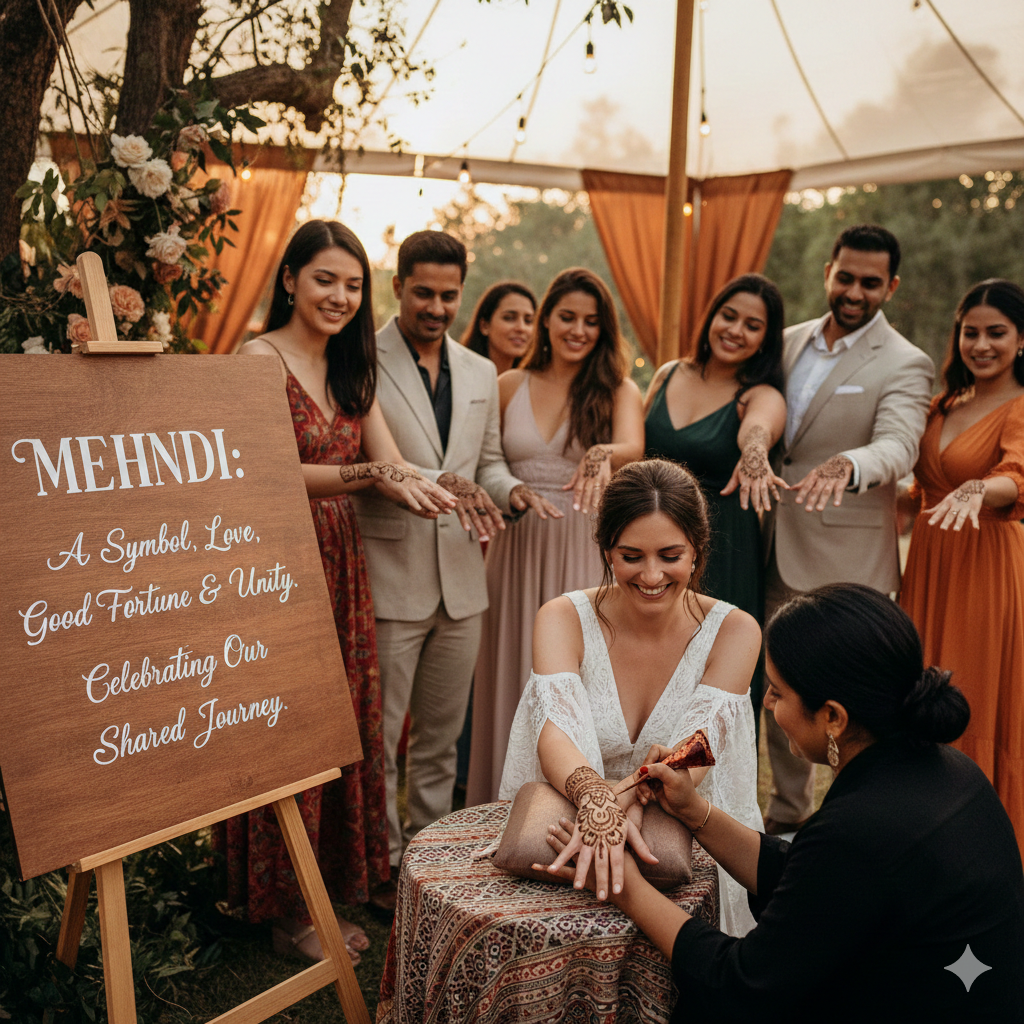
Offering mehndi to wedding guests either at the reception or at a pre-wedding event is a popular option that creates a memorable, interactive experience. A professional mehndi artist can apply simple designs to guests who want them, with more elaborate options available for the bridal party.
If you offer mehndi to guests, keep it optional and ensure your mehndi artist is prepared to briefly explain the significance of the art form to guests who are curious. This small act of education transforms what could be a novelty into a genuinely meaningful cultural exchange.
Choosing a Mehndi Style for a Non-Indian Wedding
One of the most common questions non-Indian brides ask is which mehndi style to choose.
The main options are:
- Indian/South Asian style — dense, full-coverage, intricate patterns covering hands and often extending up the arms and onto the feet. Highly detailed with figurative motifs including peacocks, paisleys, flowers, and sometimes portraits. Best suited to brides who want maximum impact and are comfortable with full coverage.
- Arabic style — bold floral and geometric patterns with open space between motifs, typically covering the hand and lower arm. Elegant, contemporary, and versatile. Works well with both traditional and modern wedding aesthetics. Popular choice for non-Indian brides.
- Moroccan / Berber style — angular, geometric patterns with a distinctive North African character. Particularly striking in black henna paste. Suits brides drawn to more abstract, structural art.
- Minimalist / contemporary style — clean line work, single flowers, delicate wrist or finger designs. The most accessible style for brides who want a subtle nod to henna culture rather than full bridal coverage.
For a full comparison with photos and guidance: Arabic Mehndi vs Indian Mehndi — 7 Differences (Which Suits You?) [INTERNAL LINK: https://mehndidesignz.com/arabic-mehndi-vs-indian-mehndi/]
What to Expect From a Mehndi Session
If this is your first time having mehndi applied professionally, here is what to expect:
Consultation — your artist will discuss design options, coverage, and any preferences before beginning. Bring reference images if you have them.
- Application — the artist applies henna paste using a cone or applicator bottle. A full bridal hand and arm design takes 2–4 hours. A simple guest design takes 10–20 minutes.
- Drying and setting — once applied, the paste must be left undisturbed to dry for at least 1–2 hours. Your artist will advise you to keep the paste on as long as possible — ideally 6–8 hours — for the darkest result.
- Removing the paste — scrape (do not wash) the dried paste off. Avoid water for the first few hours after removal.
- Colour development — mehndi continues to darken for 24–48 hours after removal. Your final colour is typically visible 48 hours after application.
For full aftercare instructions: How to Remove Mehndi from Hands
Frequently Asked Questions
Is mehndi only meant for Indian weddings
No. Mehndi originated across multiple cultures simultaneously — South Asian, Middle Eastern, and North African communities have all practiced henna art for thousands of years. It has always been a multicultural tradition. Today, mehndi is regularly incorporated into British, American, French, Canadian, and Australian weddings by couples of all backgrounds. What matters is that it is approached with awareness and respect for its cultural roots.
Can non-Indian couples use mehndi without it being cultural appropriation?
Yes, provided the intent is appreciation rather than mockery or ignorance. Engaging with mehndi thoughtfully — learning its symbolism, working with a professional artist, acknowledging its origins, and choosing designs with personal meaning — is cultural appreciation, not appropriation. Many South Asian mehndi artists actively welcome non-Indian clients and see cross-cultural engagement with henna as a positive form of cultural exchange.
Does mehndi have religious significance
Mehndi is primarily cultural rather than religious. It is practised by Hindu, Muslim, Sikh, Christian, and Jewish communities across South Asia, the Middle East, and North Africa. It is not tied to any single religion. In weddings, it represents celebration, transition, and good fortune — meanings that transcend religious boundaries. Non-Indian brides of any faith can incorporate mehndi without any conflict with their own religious tradition.
When should mehndi be applied for non-Indian weddings
Mehndi should be applied 48–72 hours before your wedding day to allow the colour to fully develop. Applying it the night before often results in paste that is still present on your wedding morning, which can be inconvenient. Applying it 3 days before gives the deepest colour and ensures your hands are clean and stain-only on your wedding day. For a complete timeline including all beauty appointments, read our Bridal Mehndi Timeline guide. [INTERNAL LINK: https://mehndidesignz.com/bridal-mehndi-timeline/]
What does it cost to have mehndi applied for a non-Indian wedding?
Cost depends heavily on your country and the coverage you want. In the UK, a bridal mehndi session typically costs £150–£400. In the USA, expect $150–$500. In the UAE, AED 600–2,500. Simple guest designs start from £20–40 per person in the UK. For a full breakdown by country and city, read our complete guide: Bridal Mehndi Cost in Different Countries — 2026 Price Guide. [INTERNAL LINK: https://mehndidesignz.com/bridal-mehndi-cost-in-different-countries/]
How do I find a mehndi artist for a non-Indian wedding?
Final Thoughts
Mehndi’s greatest quality is its ability to carry meaning across cultural boundaries without losing its integrity. A Moroccan bride in Paris, a South Asian bride in Birmingham, and a British bride in London can all sit with a mehndi artist and experience something that is simultaneously ancient and entirely personal.
For non-Indian couples, mehndi offers what most modern weddings are actively searching for — a moment that is slow, tactile, communal, and genuinely meaningful. Not a performance or a decoration, but an experience.
If you are planning to include mehndi in your wedding and want guidance on the practical side, timing, preparation, what to wear, and what questions to ask your artist explore these guides next:
– Bridal Mehndi Timeline: When to Apply Mehndi Before the Wedding
– How to Prepare Your Skin for Mehndi Application
– Bridal Mehndi Cost in Different Countries — 2026 Guide
– Plan a Mehndi Ceremony in 7 Days
– Arabic Mehndi vs Indian Mehndi — Which Style Should You Choose?
